
You've Been Asking the Wrong Question About Your College Major
Most graduates ask "what can I do with my major?" It's the wrong question. Here's the reframe that actually helps you find direction — regardless of what your diploma says.
GRADS
5/26/20263 min read

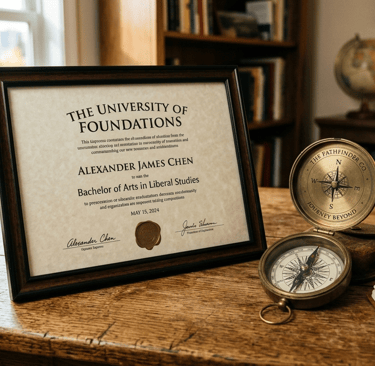
Nearly every week I talk to recent graduates who lead with some version of the same question: What can I do with my degree in communications? Or political science. Or psychology. Or whatever field they spent four years studying.
It's an understandable question. It's also the wrong one.
Not because your major does not matter — but because the way most graduates frame it assumes the degree is a destination rather than a starting point. And that assumption is quietly keeping a lot of talented people stuck.
What Your Major Actually Did For You
Here's the honest truth: most people do not end up working in the field they studied. Research from the Federal Reserve Bank of New York found that only 27 percent of college graduates work in a job directly related to their major. That means nearly three out of four graduates are doing exactly what you're worried about — building careers that do not map neatly onto their degree.
And most of them are doing just fine.
My own path is a good example. I studied Russian — at a school that did not even issue traditional majors, just a Bachelor of Arts or Bachelor of Science. Not exactly a clear career roadmap. But that background opened a door into public service, which led me to other adventures and ultimately to career coaching.
Russian studies did not define my destination. It opened the first door. The journey did the rest.
I watched the same pattern play out with a former colleague — a microbiology major who built a genuinely meaningful career in criminal justice. Not because the two fields connect directly. Because their degree proved something more fundamental: that they could reason logically, master complex material, and think analytically under pressure. The hiring manager did not need a microbiology expert. He needed someone who could think. The degree was the proof.
That is what your major actually did for you. Not a job title. A set of capabilities.
The Question Worth Asking Instead
When I work with recent graduates who feel stuck on this question, I do not start with the degree. I start with two simpler questions.
What do you hope to do? Not what are you qualified for — what do you actually want? Even a partial answer, even a direction rather than a destination, gives us something to work with.
What did you learn to do? Not the subject matter — the skills. A communications major learned to write clearly, distill complex ideas, and connect with an audience. A political science major learned to analyze systems, construct arguments, and understand how decisions get made. A psychology major learned to observe human behavior, identify patterns, and ask better questions.
Those skills transfer. Every single one of them. The question is where you want to apply them — and that has nothing to do with what your diploma says.
The Reframe
Most graduates approach the job market as if their degree is a key that only opens certain doors. It is not. It is proof that you can learn, think, and complete complex work over time. That proof travels with you regardless of what the degree is called.
Communications majors become data analysts, project managers, and brand strategists. Political science majors become consultants, operations directors, and policy advisors. Psychology majors become HR leaders, UX researchers, and sales professionals. The translation is rarely direct. It is almost always possible.
The students who move forward are not the ones who figured out what their major qualifies them for. They are the ones who decided what they wanted and then made the case for why their background — whatever it was — prepared them for it.
The Honest Closing
Here is something nobody tells you at graduation: by the time you figure out what you actually want to do, your major will barely come up.
What will come up is what you built, what you contributed, and what you learned along the way. The degree got you in the room. Everything after that is yours to write.
So stop asking what you can do with your major. Start asking what you want to do — and let that question lead.
What skills did your degree build that you have not yet given yourself credit for? Reply and let me know.
I read every response.
If you're not sure how to translate your background into a direction that actually fits, I'd be glad to think it through with you. A 20-minute Compass Call is a good place to start — just a conversation about where you are and where you want to be. No sales pitch. No pressure.
Book here:
Contact Us
Subscribe to our newsletter for insights & reflections to help you stay inspired on your journey.
Discover Your Direction
Find your passion, find your path.
© 2025 Discover Your Direction LLC