
What Your Performance Review Isn't Telling You
What Your Performance Review Isn't Telling You — A Mid-Career Wake-Up Call
MID-CAREER
4/13/20264 min read

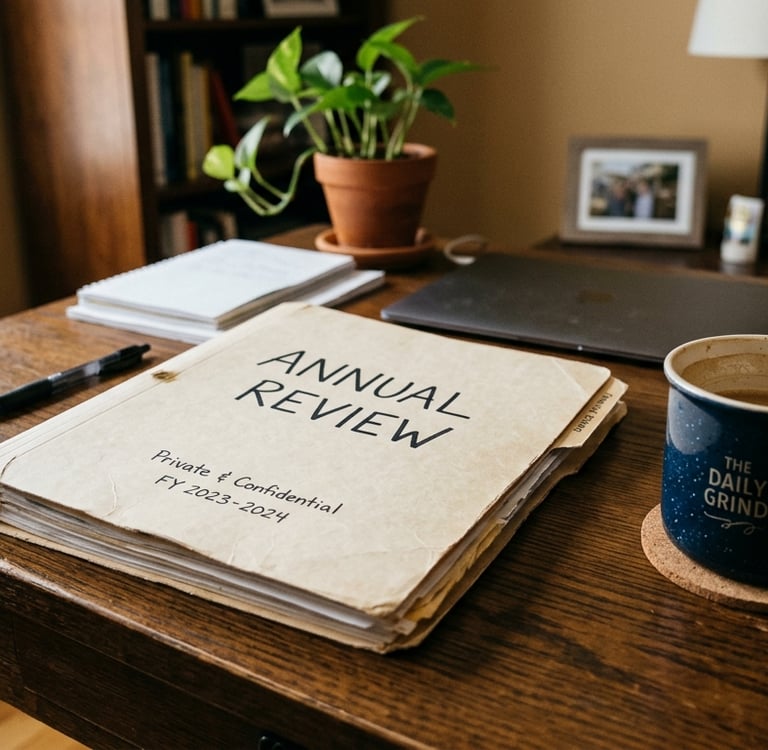
You know the routine, it's the end of the reviewing period, you review your accomplishments, highlight the key projects, and discuss them with your manager. The meeting ends. Your manager closes the folder, says something about your contributions this year, and you walk back to your desk with a good review — maybe even a great one.
And you feel nothing.
Not relief (except for the fact you don't have to do it again for a year). Not motivation to keep going. Just a quiet, unsettling so what.
If you've been there, you know how disorienting that moment is. You did everything right. The feedback was positive. The rating was solid. And somehow that makes the emptiness harder to explain, not easier.
Here's what I'd offer: that feeling is not ingratitude. It is not burnout. It is data. And most people spend years ignoring it.
The Problem With How We Use Reviews
Performance reviews are built to answer one question: How much value are you delivering to this organization?
They are thorough, structured, and — at their best — genuinely useful for that purpose. What they are not designed to do is answer the question sitting underneath that one: Is this organization still delivering value to you?
That second question rarely makes it into the room. So people walk away knowing exactly how they performed, and no clearer on whether the performance still matters to them.
Research from Gallup consistently finds that roughly two-thirds of employees are disengaged at work — present, competent, and checked out. Not failing. Just going through motions. A strong performance review does nothing to close that gap. If anything, it can widen it — confirming you're good at something you've quietly stopped caring about.
Four Ideas for Your Own Review
Here's a reframe worth sitting with: What if you used this review season to run your own assessment — not of your performance, but of your direction?
Start with the practical steps most career advisors recommend, and then take them one layer deeper.
Track what you accomplished — then notice how it feels to list it. Most professionals wait until review season to reconstruct the year, which is frustrating and incomplete. Going forward, keep a running log — a simple document or note — where you capture wins, completed projects, and meaningful contributions in the moment. It makes the review process easier. But more importantly, it gives you something to read back and actually feel. If you scan that list and feel proud, energized, or eager to do more — that's a signal. If you feel relief that it's over, or a kind of flatness, that's a signal too. Both matter.
Identify goals for the coming year — then ask yourself honestly if you want them. Goal-setting is standard review practice. Most people approach it as an exercise in what the organization needs from them. Try reversing it: What do you actually want from the next twelve months? Not what sounds good on paper — what would genuinely excite you to accomplish? If you can't find an honest answer, that gap is worth paying attention to.
Look at where your energy went, not just where your time went. Time is easy to account for — meetings, deliverables, projects. Energy is harder. Think back over the past year: which work pulled you forward? Which work drained you before you'd even started? The ratio matters more than the review score.
Ask yourself the question nobody asks in the room. When the meeting ends and you walk back to your desk — do you feel motivated? Indifferent? Quietly relieved it's over? That immediate reaction, before the noise of the day takes over, tells you something your manager's feedback cannot.
What the Flatness Is Actually Saying
A hollow review moment is rarely about the review. It is usually about a longer, slower drift — a career that once fit and gradually stopped. The work did not suddenly become meaningless. The meaning eroded, quietly, over time, while the performance stayed strong.
I've sat with a lot of mid-career professionals who describe this exact experience. They are not people who failed. They are people who succeeded their way into a corner — and the review just made it impossible to look away.
That is not a comfortable place to be. However, from my perspective, it is a far better place than the alternative: another year of strong performance in a direction you no longer believe in.
The flatness is not the problem. It is the beginning of an answer, if you're willing to follow it.
What to Do With This
If this year's review left you with more questions than answers, I'd encourage you to resist the urge to push through and wait for the feeling to pass. It usually doesn't. What changes is your tolerance for it.
Instead, start where you are. Take ten minutes this week and write down the honest answers to two questions: What energized me most this year? And what would I need to feel genuinely excited about the next one? Is it training? Is it a new assignment or project? Is it more responsibility?
You don't need a plan yet. Nor do you need to know where this is going. You just need to start paying attention to what the data is telling you — before another year goes by and the gap grows wider.
If your review left you feeling more empty than energized, I'd be glad to think through what that might mean for you. I offer complimentary 15-minute Compass Calls — just a conversation about where you are and where you want to be. No sales pitch. No pressure.
Book Here--->
Contact Us
Subscribe to our newsletter for insights & reflections to help you stay inspired on your journey.
Discover Your Direction
Find your passion, find your path.
© 2025 Discover Your Direction LLC