
The 6 Questions Every College Student Is Asking (And How to Answer Them)
Real career questions from college students at a recent career fair—and how to think about each one. Direction matters more than tactics.
GRADS
2/23/20265 min read
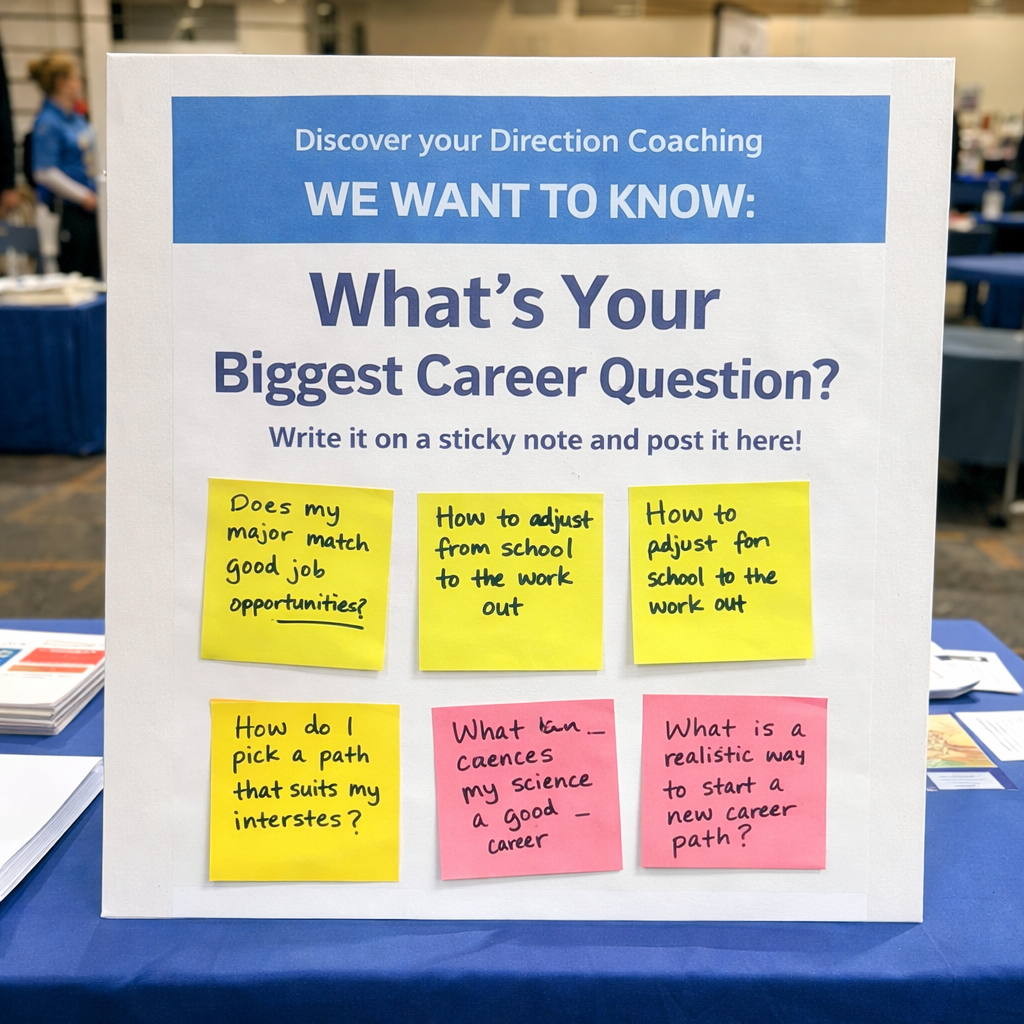
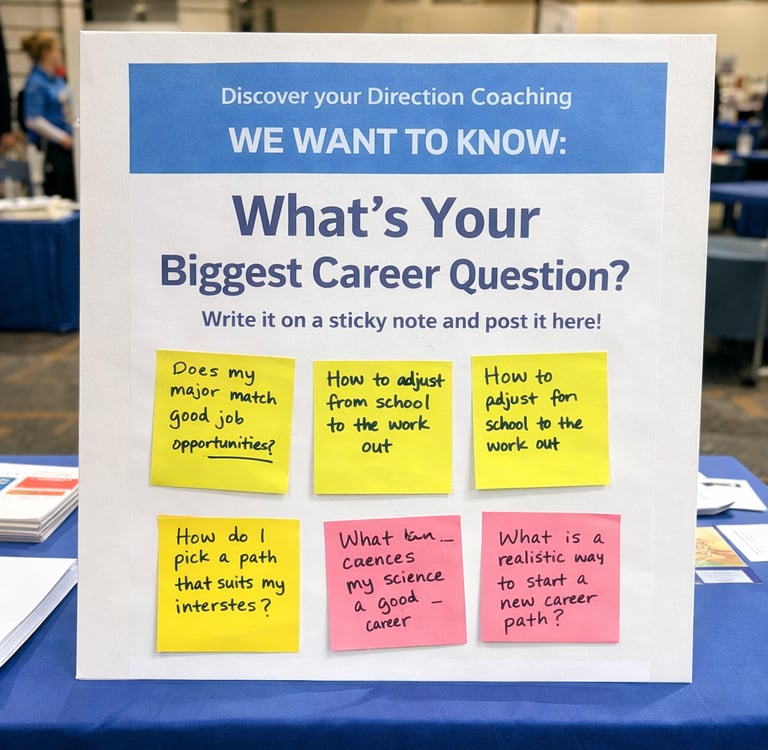
Last week I attended a regional career fair, my second in as many weeks. At my table I had a sign with one simple question: "What's your biggest career question right now?"
Students paused at the booth, grabbed markers, and wrote down what was actually on their minds. Not polished questions designed to impress recruiters. Real ones. The kind every college grad carries with them.
Here's what they wrote—and how to think about each one.
1. "What is a realistic timeframe to start a career after graduating?"
This was the most common question, and it makes sense. Everyone wants a roadmap.
Here's the honest answer: it depends on clarity, not timeline. I've seen students land roles within three months of graduation. I've seen others take considerably longer. The difference is not luck or connections—it's knowing what they want.
The students who move quickly follow a pattern: Direction first. Exploration second. Application third. Offer fourth. They spend time upfront getting clear on what they're looking for and establishing a plan, which makes every application more strategic and every interview more compelling. Of course, each student is different and every situation is dependent on a number of things. What matters is having a plan—knowing where you want to go.
The students who struggle? They skip the direction step entirely. They spray applications at anything that sounds reasonable, then wonder why nothing clicks. Timeline anxiety makes them rush, but rushing without clarity toward a defined action just extends the process. (Those are also the ones I hear from later, once they realize their career was not fitting their values, character, or strengths.) If you want to shorten your timeline, slow down long enough to figure out what you're actually aiming for.
2. "What makes someone stand out in a resume?
Most students send the same generic resume to dozens of jobs, hoping something sticks. It rarely does. Recruiters can spot a copy-paste application from the first line. When your resume could belong to anyone, it belongs to no one.
What stands out is someone who clearly knows what they want and can articulate why they're pursuing it. That specificity shows up in how you describe your experience, the roles you target, and how you talk about your goals.
Generic resumes get generic results. The students who land interviews are the ones who apply strategically to roles that align with their strengths—and whose resumes reflect that alignment.
Before you optimize your bullet points, ask yourself: Do I actually know what I'm optimizing for?
3. "How do I know if I'm on the right path?"
This question has a simple answer and a harder one.
The simple answer: pay attention to your energy. When you're on the right path, work feels challenging but not draining. Sunday nights feel like anticipation, not dread. You're growing, even when it's uncomfortable.
When you're on the wrong path, you feel the opposite. The work depletes you. You watch the clock. You find yourself saying "it's fine" when people ask how things are going.
The harder answer is that "right path" is not a permanent destination. Career paths twist and evolve. What’s right for you at 24 might not be right at 34. What matters is staying attuned to whether your current work aligns with your values, uses your strengths, and holds your interest. I've had roles where the work itself felt draining, but the people were great and the mission kept me engaged. I've also worked for poorly organized companies yet still found meaning in the day-to-day challenges.
If all three are missing, that's worth paying attention to.
4. "Does my major have job opportunities?"
Let me answer this upfront: every major has opportunities.
Your major does not equal your career. English majors become data analysts. Engineering majors become consultants. Psychology majors become project managers. The translation between what you studied and what you do is seldom direct. I worked with a microbiology major who ended up in a meaningful career in the field of criminal justice.
The right question is: What do I want to do with this knowledge? Your major gave you skills—critical thinking, communication, analysis, problem-solving. Those skills transfer. The question is where you want to apply them.
When students ask "does my major have opportunities," what they're often really asking is "am I going to be okay?" The answer is yes—if you take ownership of translating your education and experience into a direction that excites you, rather than waiting for the job market to tell you what you're qualified for.
5. "How do I adjust from being a student to the actual job role?"
This transition catches almost everyone off guard, and it's not talked about enough.
School is structured. Work is ambiguous. In school, someone hands you a syllabus, tells you what to do, and grades you on completion. In work, you often have to figure out what success even looks like before you can achieve it.
School rewards individual performance. Work rewards collaboration. The student who did everything alone to prove they could handle it becomes the employee who struggles because they do not ask for help or build relationships.
The adjustment is learning a new set of unwritten rules: how to advocate for yourself without being pushy, how to network without feeling transactional, how to navigate office dynamics without getting pulled into drama.
Nobody teaches these skills in college. But they're the skills that determine whether you thrive or just survive in your first role.
6. "How do I pick between multiple interests?"
Here's the secret: you do not have to pick one forever.
The pressure to choose a single career path at 22 is a myth left over from a different era. Careers are not linear anymore. People pivot, evolve, and reinvent themselves throughout their working lives. The average person will have multiple careers—not just jobs, careers—before they retire.
So instead of trying to make a permanent decision, treat this phase as data-gathering. Test, do not commit. Internships, informational interviews, side projects, volunteering—these are all ways to explore without locking yourself in. I encourage my clients to pursue as many of these as their bandwidth allows. Job shadowing in particular is a great way to test your interest before committing to a career path, yet it's almost always overlooked.
You're not choosing a life sentence. You're choosing your next step. And that step will teach you something that informs the step after that.
The students who stay stuck are the ones waiting for certainty. The students who move forward are the ones willing to learn as they go.
What These Questions Have in Common
Reading through that question board, I noticed something: every question pointed to the same underlying need.
Students know they need direction, not just tactics. They're not asking how to format a resume or ace an interview—though those matter too. They're asking who am I, what do I want, and how do I get there?
Those are the questions worth sitting with. And they're the questions that most career resources skip right past.
If you're asking these questions too, you're not alone. If you want a guide to help you along your journey, reach out to me. I'm offering complimentary 15-minute Compass Calls this month—just a conversation about where you are and where you want to be. No sales pitch. No pressure.
Book here:--->
Contact Us
Subscribe to our newsletter for insights & reflections to help you stay inspired on your journey.
Discover Your Direction
Find your passion, find your path.
© 2025 Discover Your Direction LLC