

The Direction Report - June 2026


Bella graduated last spring from the College of Charleston with a degree in psychology. She knew she didn't want to be a psychologist, so she started applying for anything — sales, receptionist, food and beverage, she told Marketplace in January. She's been at it since August. Every day she blocks out four hours on job boards, uploading her resume and clicking apply.
Four hours. Every day. Months on end.
The problem is not Bella's work ethic. The problem is the strategy — and it's not uniquely hers. It's the default approach of an entire generation of graduates entering the most structurally unusual job market in a generation.
The Numbers This Month
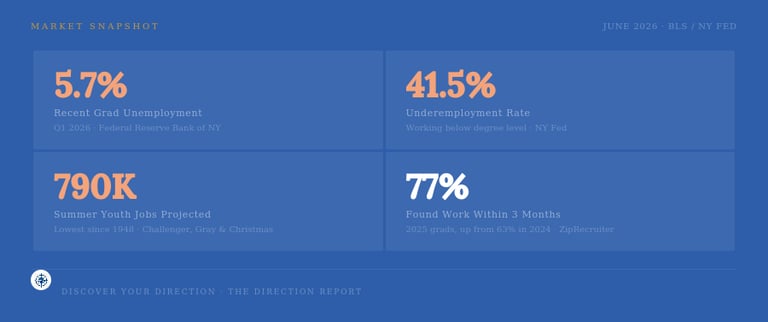
The unemployment rate for recent college graduates sat at roughly 5.7 percent in the first quarter of 2026, with an underemployment rate of 41.5 percent, according to the Federal Reserve Bank of New York. That underemployment figure — four in ten recent graduates working jobs that don't require their degree — is the quiet headline most people miss.
The summer picture is no easier. Youth unemployment reached 10.8 percent in July 2025, up from 9.8 percent the year before, and forecasters do not expect meaningful improvement this summer. Challenger, Gray & Christmas projects teens and young adults will gain roughly 790,000 jobs during May, June, and July of 2026 — which would mark the lowest summer hiring total since BLS began tracking the data in 1948.
Nearly 20 percent of companies report they plan to hire fewer interns or none at all in 2026, according to Drexel University's 2026 College Hiring Outlook.
Those numbers deserve to be named honestly. This is not a normal entry-level market.
The Inversion
Here is what makes this moment genuinely different from previous slow cycles — and what the headline unemployment rate doesn't capture.
The young college graduate unemployment rate has recently surpassed the overall unemployment rate, meaning a greater share of young college graduates are now out of work than the labor market as a whole. That inversion is historically unusual. For most of the past four decades, a degree functioned as a labor market shield. Since 2023, roughly 85 percent of the rise in the unemployment rate has been concentrated in new market entrants, and the rise in unemployment for college graduates has been triple that of the broader workforce.
Where a typical college graduate once found a job in about two to two and a half months — compared to four to four and a half months for a high school graduate — both groups now take about four and a half months. The gap that once defined the value of a degree in the job market has essentially closed.
The question is why — and what to do about it.
The data suggests overall employment has not necessarily declined, but hiring has, which disproportionately impacts those looking for entry-level positions. Companies are cautious. They are not laying people off at alarming rates — they are simply not opening the front door. And when the front door stays closed, the people most affected are the ones who have not yet gotten inside.
The Degree Didn't Change. The Market Did.
What the Market Is Actually Rewarding
This is where I want to push back on the narrative a little — because data alone can slide into paralysis if you let it.
Marketplace recently ran a conversation with New York Times journalist Jodi Kantor, whose new book is aimed squarely at this generation. Her argument: "The single worst piece of advice right now is that everything is doomed." A person, she said, is not a statistic. The disruption happening right now always creates significant opportunities — for those who can identify them.
Her framework is worth sitting with. She calls it craft plus need: craft is the specific skill you have that other people do not, the thing that makes you not interchangeable. Need is the gap in the market — the real-world problem your craft can solve.
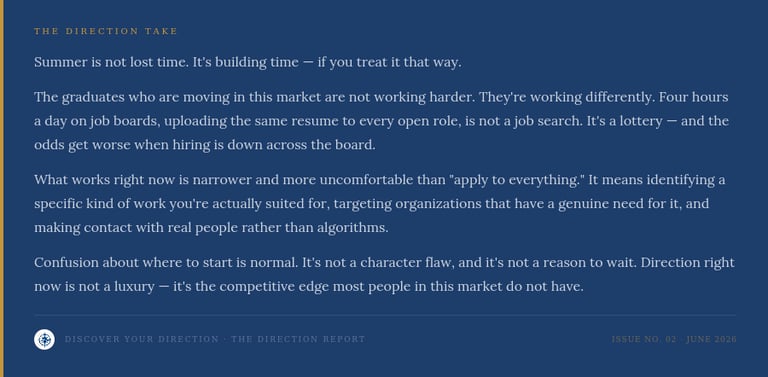
That framing maps almost exactly onto what I see in coaching. The graduates who move through this market are not the ones applying to everything. They're the ones who can answer two questions with precision: What do I do well that others don't? And where does someone actually need that?
Here's a data point that doesn't get enough attention: 77 percent of 2025 graduates landed their job within three months of earning their degree, according to ZipRecruiter's 2026 report — up sharply from 63 percent of 2024 graduates. In a market that is objectively harder, more graduates are finding jobs faster. The difference is not luck. It's specificity.
Even in internships, the divergence is visible. While overall intern hiring is contracting, companies investing heavily in AI are actively growing their internship programs — recruiting younger workers specifically to help organizations learn how to use these tools. The generic internship is getting cut. The targeted one — where you bring something specific to a problem the company is actually trying to solve — is still very much available.
What's one thing you've tried in your job search that actually worked — or didn't?
If this market has you second-guessing your direction, a Compass Call might be worth 15 minutes. No pitch, no pressure. Just a conversation about where you are and what clarity could look like from here.
Book here:
Reply here: Chris@Discoveryourdirectioncoaching.com
I read every message.
Contact Us
Subscribe to our newsletter for insights & reflections to help you stay inspired on your journey.
Discover Your Direction
Find your passion, find your path.
© 2025 Discover Your Direction LLC